

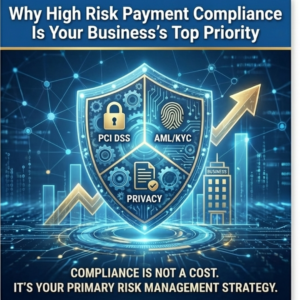
TL;DR Navigating the increasingly complex landscape of high risk payments compliance is not just about avoiding fines; it is about building a foundation for sustainable, long term growth. For high risk merchants, this means staying ahead of updates like PCI DSS 4.0, strengthening AML/KYC protocols, and adapting to new state level data privacy laws. Bankcard International Group is your compliance partner, offering the expertise and secure technology to ensure your operation remains compliant, secure, and profitable in 2025 and beyond.
Why High Risk Payments Compliance Is Your Business’s Top Priority
For CFOs, CEOs, and senior decision makers in specialized industries, compliance often feels like a moving target. It is expensive, technical, and constantly changing. But in high risk payments, compliance is not a background obligation. It is your primary risk management and business continuity strategy.
Modern payment compliance is built on three pillars: card brand security, anti financial crime controls, and consumer data protection. Failure in any one area can result in fines, frozen funds, increased reserves, or outright merchant account termination. In high risk categories, tolerance for error is extremely low.
The Three Pillars of Modern High Risk Payments Compliance
High risk merchants operate under enhanced scrutiny from acquiring banks, card brands, and regulators. Approval is not the finish line. Compliance is continuously monitored and enforced.
Payment Card Industry Data Security Standard (PCI DSS)
PCI DSS is the global standard for protecting cardholder data. For high risk businesses, compliance is mandatory and ongoing. The introduction of PCI DSS 4.0 represents the most significant update in years and requires immediate attention.
Key PCI DSS 4.0 considerations for high risk merchants:
- Customized compliance paths
PCI DSS 4.0 allows a Customized Approach for meeting certain controls. While this provides flexibility, it also requires detailed documentation, risk justification, and internal governance. Poor documentation is one of the most common causes of audit failure. - Stronger authentication requirements
Multi factor authentication is now required for all access to the Cardholder Data Environment, not just remote access. This includes administrators, vendors, and internal staff. - Tokenization and scope reduction
Reducing the amount of sensitive data your business handles remains the most effective way to lower risk. Tokenization replaces card data with non sensitive values, dramatically shrinking PCI scope and reducing breach exposure.
Anti Money Laundering (AML) and Know Your Customer (KYC)
AML and KYC requirements are enforced by the U.S. Treasury’s Financial Crimes Enforcement Network. These rules are designed to prevent fraud, money laundering, and illicit activity across the financial system.
For high risk industries, enforcement is stricter and expectations are higher.
Core AML and KYC requirements include:
- Enhanced due diligence
High risk merchants undergo deeper review of ownership structures, business models, product claims, fulfillment practices, and customer acquisition channels. - Ongoing monitoring
Compliance does not stop after onboarding. Transaction behavior, volume changes, refund activity, and customer complaints are continuously monitored. - Identity driven fraud prevention
Strong KYC controls help prevent account takeover fraud and synthetic identity fraud, which are increasingly common in ecommerce and subscription billing.

State Level Consumer Data Privacy Laws
State level data privacy laws increasingly impact payment operations. While these laws are not payment regulations themselves, they govern how customer data is collected, stored, and shared during transactions.
What high risk merchants must address:
- Up to date privacy policies
Privacy disclosures must align with the laws of the states where customers reside. - Clear data handling transparency
Merchants must clearly explain what data is collected, how it is used, who it is shared with, and how customers can opt out when required.
Failure to meet these expectations can trigger enforcement actions, customer complaints, and processor risk reviews.
What High Risk Payment Compliance Looks Like in Practice
Compliance is not a one time checklist. It is an ongoing operational discipline.
For most high risk merchants, compliance includes:
- Initial underwriting with enhanced documentation review
- PCI scoping and annual validation
- Quarterly or event driven risk reviews
- Continuous transaction monitoring
- Re underwriting triggered by volume changes, complaints, or regulatory shifts
Common triggers for increased scrutiny include sudden sales spikes, product changes, chargeback increases, new marketing channels, or negative media coverage.
Merchants that proactively communicate changes and maintain clean documentation are far more likely to retain account stability.

Common High Risk Payments Compliance Failures That Lead to Termination
Many high risk merchant accounts are terminated not because of fraud, but because of preventable compliance failures.
Common issues include:
- Incomplete or outdated business disclosures
- Misalignment between approved products and actual sales
- Weak refund, cancellation, or customer support policies
- Poor PCI documentation or audit readiness
- Assuming initial approval equals ongoing compliance
In high risk categories, these issues often result in immediate termination rather than warnings.
The Cost of Non Compliance for High Risk Merchants
The financial consequences of non compliance far exceed the cost of prevention. For high risk merchants, penalties escalate quickly.
Typical impacts include:
- PCI DSS fines ranging from $5,000 to $100,000 per month until resolved
- Average U.S. data breach costs exceeding $4.45 million
- Immediate merchant account termination and loss of payment acceptance
- Long term difficulty securing new processing relationships
Once terminated, many merchants are placed on monitoring lists that limit access to banking services for years.
Choosing a Payment Partner That Prioritizes High Risk Payments Compliance
A payment provider should be more than a transaction processor. For high risk businesses, your processor must function as a compliance partner.
Bankcard International Group supports merchants with proactive compliance strategies designed for long term stability.
How BIG supports high risk payment compliance:
- Regular compliance reviews of processing environments and procedures
- Integrated fraud prevention tools including AVS, CVV, and 3D Secure
- Tokenization and gateway architecture that reduce data exposure
- Expert guidance tailored to high risk industries and regulatory realities
The goal is not just approval. It is sustainability.
Turning High Risk Payments Compliance Into a Competitive Advantage
When managed correctly, compliance becomes an asset rather than a burden. Strong PCI controls, robust AML and KYC processes, and transparent data practices build trust with banks, customers, and partners.
For high risk businesses, compliance is what protects revenue, preserves access to payments, and enables long term expansion.
Ready to Strengthen Your High Risk Payments Compliance Strategy?
If your business operates in a high risk category, the right payment partner makes the difference between constant disruption and long term stability.
Contact Bankcard International Group at 1-800-895-1580, email info@bighqs.com, or visit bankcardinternationalgroup.com to get started.
FAQs About High Risk Payments Compliance
What is the biggest PCI DSS 4.0 challenge for high risk merchants?
Why are AML and KYC critical for high risk businesses?
What penalties exist for PCI DSS non compliance?
How can a payment processor support data privacy compliance?
How often are high risk merchants reviewed for compliance?
What triggers merchant account termination in high risk industries?
What is the most common compliance mistake high risk merchants make?